

Bookkeeping is very critical in the running of any business. It gives you an accurate state of your financial strength, it helps in decision-making, and it also helps in tax compliances. But when making bookkeeping, even slight mistakes may result in significant loss, and this is financial statement errors, cash flow problem or even pay fines.
To assist you to be at the right path, this guide highlights five typical bookkeeping errors that the businesses performed and it suggests practical ways of avoiding these errors. Regardless of whether you have been in business a long time or you are still new to it, these are the mistakes you can understand and therefore prevent or at least make them less costly in terms of time, finances and stress.
Mistake 1: Failing to Separate Business and Personal Finances
Why This Mistake Happens
This is because most of the small business owners especially when it is in its early stages find it best to do all their transactions under the same account which is both personal and business. This tends to occur because of convenience, lack of any formal structure or ignorance on the need to ensure that separate records are kept.
The Impact of This Mistake
- Complexity in Accounting: Combination of transactions complicates the way expenses bought together ought to be categorized, money coming in or like reconciling accounts.
- Tax Complications: It makes it hard to deduct things and more things may be missed or misreported in terms of business expenses or business income that will attract taxes.
- Legal Risks: In an LLC or corporation, it is possible to undermine legal distinction between a business and the person through a lack of financial segregation, which creates liabilities.
How to Avoid It
- Open a Separate Business Bank Account. Make sure that all the business income and expenditure goes through this account.
- Use a Business Credit Card. It will be easier to keep a record of purchase and to keep their own credit independent.
- Establish Clear Policies. It is always advisable to avoid using business money to clear personal bills and vice versa.
Pro Tip: You may enlist the assistance of the digital payment resources or accounting services such as QuickBooks or Xero to facilitate the ease of organizing the transactions.
Mistake 2: Not Keeping Receipts and Records
Why This Mistake Happens
Due to limitation in records of business, sometimes they do not store hard copies and soft copies of receipts and they merely use bank statements to trace the expenses. Some may also lose records by accident as a result of not being organized.
The Impact of This Mistake
- Missed Deductions: You will also lose allowable business write-offs in the event you fail to have proper documentation to prove the write-off.
- Tax Audits: Lack of orderly records puts your business at the risk of penalties in the event that it is audited by the tax collectors, including the IRS and other taxing agencies.
- Reduced Visibility: Incomplete financial reports as a result of unrecording the transactions that will not enable to make good decision making.
How to Avoid It
- Digitize Receipts. Such apps as Expensify or Receipt Bank allow to scan and upload receipts in a safe place.
- Create a Habit. Allocate time each week in order to arrange and enter a record on the transactions.
- Implement a Filing System. Categorize the group spending in marketing, operations, or even travel and make it easy to get the records of such expenditures when required.
Pro Tip: There are even receipt-tracking applications these days with which you can weave your accounting tool to lower your manual errors and increase accuracy.
Mistake 3: Misclassifying Expenses
Why This Mistake Happens
Bookkeeping deals with classifying transactions and this may lead to a business classifying certain expenses to the wrong category due to lack of knowledge or in the case of confusion.
The Impact of This Mistake
- Financial Implications of Misclassification: This can interfere with reports and lead to the inability to determine the success of a budgetary performance, profitability etc.
- Potential Tax Problems: The issue of misclassifications on deductions may attract the attention of tax authorities when carried out during an audit or impose some penalties upon improper reporting.
How to Avoid It
- Know IRS Classifications Learn what are the main types of expenses as rent, utilities, or wages of employees.
- Leverage accounting software Such software as FreshBooks or Wave perform auto-categorization of such repeating expenses which minimizes the occurrence of mistakes.
- Consult Professionals in case of doubt, consult a bookkeeper or an accountant who will be able to adjust any expenses.
Pro Tip: It is best to have a personal chart of accounts with all the accounts that they deem relevant to their business to create uniformity in how expenses are categorized.
Mistake 4: Ignoring Regular Reconciliation
Why This Mistake Happens
The owners of a business can also fail to reconcile because of time reasons or the impression that the financial activity is following. Alternatively, they will not get the importance of making regular comparisons of the records.
The Impact of This Mistake
- Discrepancies: Unreconciled accounts may not be noticed and thus they may cause too much income, missing payments or even fraud.
- Cash Flow Issues: Cash flow problems always arise when businesses are not reconciled routinely which may lead to overdrafts or slow payment of accounts.
- Missed Errors: Errors in any area or repeated entries could pile up making it a long term issue.
How to Avoid It
- Reconcile Monthly: Compare your bank statements with records at least once a month in order to detect the inconsistencies.
- Automate as much as you can: The matching of transactions are made easy with the help of reconciliation tools in most of the accounting platforms.
- Spot-Check Transactions: Large or unusual entries are some of the entries that should be watched keenly and this should be confirmed through receipt or invoice.
Pro Tip: Create calendar reminders to keep the reconciliation activities in check to have consistency in the practice.
Mistake 5: Doing It All Yourself
Why This Mistake Happens
The small business owners tend to have to wear the hat of the bookkeeper among others trying to cut down the cost. Bookkeeping is also a profession and requires patients and accuracy, which many of the business proprietors may not have time.
The Impact of This Mistake
- Miscalculations and Omissions: Factors that contribute to these include lack of education as it will easily result in errors in calculating or failure to record.
- Burnout: Having excess duties places pressure and creates distraction to the capability to accomplish both bookkeeping and strategy leadership.
- Opportunity Costs: The time solving bookkeeping problems can be used in initiatives that can be used to ensure growth such as marketing or product invention.
How to Avoid It
- Hire Professional Bookkeepers. When one outsources the work to professionals it means that they will have accurate up to date books.
- Invest in Technology. Manual reconciliations of bank accounts, invoices, and payroll printing should be replaced with bookkeeping software.
- Review Periodically. In case you outsource make it a habit to glance through important reports (e.g., profit and loss statements).
Pro Tip: You do not have to spend a fortune when outsourcing. Lots of companies present expandable bookkeeping schemes that fit the budget of the business.
Final Thoughts
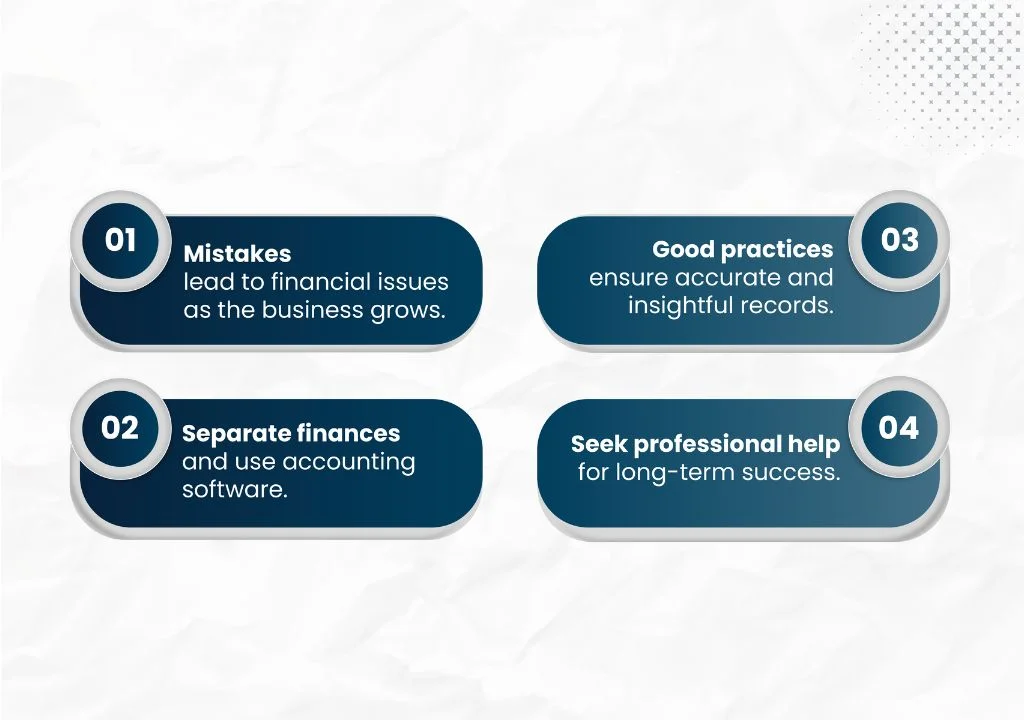
It is important to note that mistakes in bookkeeping may seem irrelevant at the beginning but as it grows bigger, the effects can range into improper management of finances, violation of tax laws, and losing good opportunities. The good tidings? Preferably insofar as they are translated into terms of political and economic advantage, for it is they we seek. With the help of this subject it will be understood to avoid these known pitfalls and developing viable solutions, financial records will not only be accurate and compliant but also more insightful.
You need to start keeping your personal and business finances separate, digitalize the receipts and use accounting software, and do not be afraid to seek professional assistance. Keeping your bookkeeping practices tidy not only means that you are a tidy person, but that will be evident to your long term business success.