

The process of running a successful business cannot be reduced only to high quality of products or services provided, but effective money management that ensures the upsurge and sustainability of the company. Strategic financial planning is involved in a good financial plan that does not only ensure you achieve your objectives but also makes you ready to react to change.
Owning a business is undoubtedly one of the most exciting jobs or careers to take on, but when an organization is faced with mostly unforeseen circumstances of declining cash balance, profitability, and whether to take down the company altogether, things can become messy very quickly. This article goes in deep into the reasons why strategic financial planning is a crucial aspect of doing business, the elements of strategic financial planning, and practical steps.
What Is Strategic Financial Planning?
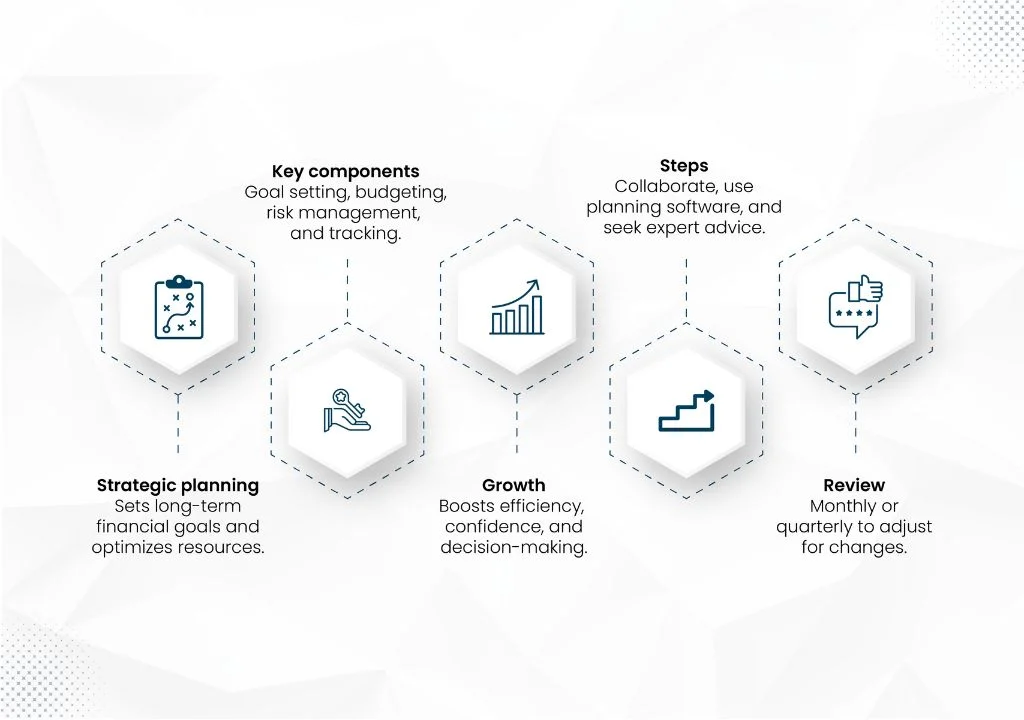
Strategic financial planning refers to the process in which financial objectives are established over a certain period of time, plans are developed and it ensure that the resources are well utilized. Contrary to the simple budget (and to the accounting) which is aimed, in a daily use, at following the ups and downs of expenses or profits, a strategy of long term financial orientation depends on the overall business goals.
Why Is It Important?
- Enables Long-Term Survival: It ensures a long-term survival by supporting your potential scale of a business, launch of the new product, and expansion to unexplored markets, without endangering your financial health.
- Facilitates Resource Optimization: The strategic planning process makes sure that all the money is utilized efficiently and with a maximum as far as ROI on investments is concerned.
- Helps You to Be Prepared about Risks: It helps you be ready about the risks as one takes care to factor in any possible risk; hence preparing one against risks.
- Encourages Shareholders: It will be easier to attract investors, lenders, and partners when there are clear plans on how to use money.
Key Components of Strategic Financial Planning
In a bid to come up with a quality plan, you should concentrate on the following elements:
1. Goal Setting
The most consistent way of doing strategic planning is to set up clear, quantified realistic financial objectives. These may involve revenue growth, cutting of operations, attaining a level of net profit or raising finance to go into an expansion.
Step-by-Step Goal Setting:
- Be Specific: As opposed to a rather broad target such as to grow revenue, you can set measurable targets such as grow revenue by 20 % in the next fiscal.
- Timelines: Set your goals into quarters or a year to see the progress accordingly.
- Prioritize: Prioritize according to the goals that fulfill both immediate needs and long term objectives: entering new markets or raising the margins.
2. Financial Analysis
A comprehensive review of your present-day financial position is critical in the aspect of strategic planning. This involves checking your income statements, balance sheets, and cash flow among others in order to determine your financial wellness.
Key Metrics to Monitor:
- Profit Margins: Is your profit income enough with respect to the amount of revenue it has received?
- Cash Flow: Does your business operate in the black or does it have a problem with its short term bills?
- Debt Ratios: What are the debts on your account and how does it act to your flexibility of operations?
Pro Tip: Make use of financial dashboards or software that aides you in noticing patterns thus giving visualisation of areas of weaknesses in your financial reports.
3. Budgeting and Forecasting
Budgeting offers a guide through which you can have a tight control over your low cost and manage your spending in terms of which areas are given priority. Conversely, financial forecasting looks at the performance in future based upon the present trends and assists you plan the alterations in market forces or the interior expenses.
How to Excel at Budgeting:
- Zero-Based Budgeting: Reconstruct your budget every time, which will make sure that all the money you invest has a reason to be there.
- Scenario Planning: Write up of the best-case, worst-case and expected-case predictions to ready yourself in the event of different results.
4. Risk Management
There cannot be any financial plan without treating risks. Strategic financial plan guides the incorporation of the mechanisms that will enable recognition, assessment, and abatement of risks that may hinder your movement.
Common Business Risks to Address:
- Market volatility.
- Disruptions in cash flow Cash flow disruptions
- The problem of abidance by regulations
- The risk of cybersecurity (especially, to non-tech dependent companies).
Risk management techniques such as the use of policies in insurance, financial reserves, and diversification are some of the strategies that can cushion your business against these risks.
5. Performance Tracking and Adjustments
The statement that is enough to make a plan is not the case, but you also need to make sure that your business is going as per the plan. Periodical evaluation will keep the performance under check and provides the information that which areas have to be modified.
What to Track:
- Key performance indicators: Key performance indicators like expansion of sales, customer acquisition cost or returns on investment.
- Variance Reports: Investigate the difference between expected results in your budget and the reality.
Actionable Tip: Try conducting monthly or quarterly reviews so that you can bring your strategy to resonate with the situation in business.
Actionable Steps to Implement Strategic Financial Planning
Step 1: Engage Stakeholders
Financial planning should not be the kind of thing that is done by the finance department. Seek ideas with the department heads, team leaders or external consultants so that there is cover on every area of operation in the business.
Step 2: Use Technology
Use tools and software that makes the process of planning easier. One way is to use a cloud accounting software such as QuickBooks, an expense tracking app such as Expensify and forecast system such as Spotlight Reporting all of which will make the process simpler.
Step 3: Build Robust Contingency Plans
Anticipate and prepare for such issues like slow seasons, supply chain problems or economic recession. Keep an emergency fund to be used when unexpected expenses which cannot be met without affecting long-term plans are faced.
Step 4: Invest in Professional Advice
It can be valuable to consult with financial advisors or strategists to enlist their advice in the course of your planning. These experts have knowledge on the industry you are in, tax optimization, or knowledge on investments to make which fit your business.
Step 5: Align with Business Objectives
A financial plan will only be efficient when we coordinate with the rest of business strategies. To give an example, in case you have a business aim of going global, this should be reflected in your financial plan with respect to allocating sufficient funds towards adding an additional marketing component, regulatory requirements and staffing in new markets.
The Benefits of Strategic Financial Planning
A properly implemented financial strategy drives the long-term growth and flexibility. Strategic financial planning is the one that can improve business growth in the following ways:
1. Boosts Efficiency
Strategic planning gets rid of inefficiencies in the operations. Managing resources enables you to take measures that result in cutting down on wastages and therefore increasing the profit margins.
2. Supports Funding Efforts
Lenders and investors are likely to assist those businesses that have a clear direction in terms of financial orientation. Your plan reflects on the fact that you will ramp up in a responsible manner and will spur returns.
3. Facilitates Long-Term Decision-Making
Short term decision making is not in concurrence to the goals of a sustainable growth. Financial planning is useful in that it allows the business to make well-thought-out decisions like where to invest, whether to make a new hire or expansion.
4. Builds Resilience
You make your risk and uncertainty planning and hence are in better place to face unanticipated problems and overcome them, be stronger than before.
Final Thoughts
Strategic financial planning is not limited to number crunching but is to create a picture of the future of your business and also create steps to achieve the same. It will enable you to know how to set proper goals, allocation of resources, and how to mitigate risks and set your business up to grow; at the same time, being highly responsive when hardships strike.
Above all, one must remain consistent. Review and readjust your plan on a regular basis and where the need be use tools and the help of experts. A proper financial plot is going to give people the confidence not only in you as a business owner but also in your business.
Start at one point and begin your planning of strategic financial planning today as it will help see your business gain perspective in its growth plans.
FAQs: How Strategic Financial Planning Can Boost Your Business Growth
1. What is strategic financial planning and why is it important for a business?
Strategic financial planning is the process of setting long-term financial goals, developing plans to achieve them, and ensuring optimal use of resources. It helps businesses survive long-term, optimize investments, manage risks, and attract investors by demonstrating clear financial direction.
2. What are the key components of strategic financial planning?
Key components include goal setting with specific, measurable targets; financial analysis of current health; budgeting and forecasting; risk management; and ongoing performance tracking to adapt plans as needed.
3. How does strategic financial planning improve business growth?
It boosts operational efficiency by eliminating waste, supports funding efforts by building investor confidence, facilitates well-informed long-term decisions, and builds resilience by preparing for risks and uncertainties.
4. What practical steps should businesses take to implement strategic financial planning?
Businesses should involve stakeholders from across the company, leverage financial planning software, build contingency plans for uncertainties, seek expert financial advice, and ensure alignment between financial and overall business objectives.
5. How often should a business review and adjust its financial plan?
Regular reviews—monthly or quarterly—are recommended to track key performance indicators and compare actual results against budgets. This allows timely adjustments to keep financial strategies aligned with changing business conditions.