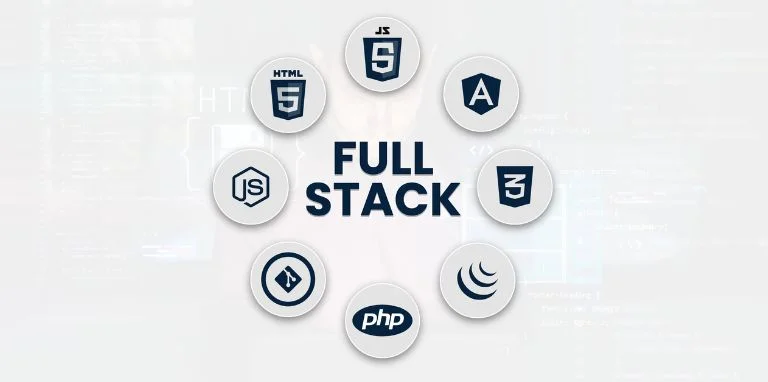
The availability of the appropriate development resources is what will either make or break a digital project. Regardless of the type of web platform you develop, a mobile app, or a business-essential piece of software, the talent selection is paramount. One of the possible alternatives that have become very popular is the collaboration with a full-stack development team.
The full-stack developers are the Swiss army knives of the development world. They possess skills in both front-end and back-end technologies, and therefore, they can deal with all the components of a project, including conceptualization and deployment. In case you are curious why you need to consider the full-stack development partner as a service provider to your projects, this in-depth guide explores the most important benefits, real-life application, and strategic value.
What Is Full-Stack Development?
Before going into the reasons as to why full-stack development is a good idea, it is necessary to discuss what full-stack development is. Full-stack development is the act of being able to handle both the front-end (user interface and experience) and back-end (server-side logic, database management) of a given project at the same time. Full-stack developers are capable of working with a wide variety of technologies and this implies that they are able to:
- Make responsive websites with the help of such front-end frameworks as React, Angular or Vue.js.
- The back-end frameworks are either the node.js, Ruby on Rails or Django.
- Database systems (SQL and NoSQL) and APIs can control the flow of data to make sure that it is smooth.
- Cooperate in the area of the systems architecture, security and the release of the product.
With this versatility, partnering with full-stack experts presents unmatched advantages.
Advantages of a Full-Stack Development Partner
1. Comprehensive Expertise Across the Technology Stack
Full-stack developers do not work in a single domain only, they know the whole picture of how all levels of a project work in unison. This whole experience comprises of
- Front-End Development: Designing user-friendly interfaces that are appealing to the eye so as to give the users an easy time.
- Back-End Development: The logic would be installed, and the database connectivity and server would be installed that would drive the application.
- DevOps Practices: The pipelines of the deployment and the performance optimization of the project once it is online.
Such a combination of knowledge makes sure that nothing in a project is missed. A full-stack team can deal with any problem you encounter, whether it is a design problem or a bottleneck in the server-side.
Example Use Case: In case of an e-commerce site, a full-stack partner would be in a position to optimize user interface to reduce cart abandonments, and also implement the back-end system that would be capable of handling peak traffic during a sale.
2. Faster Development Timelines
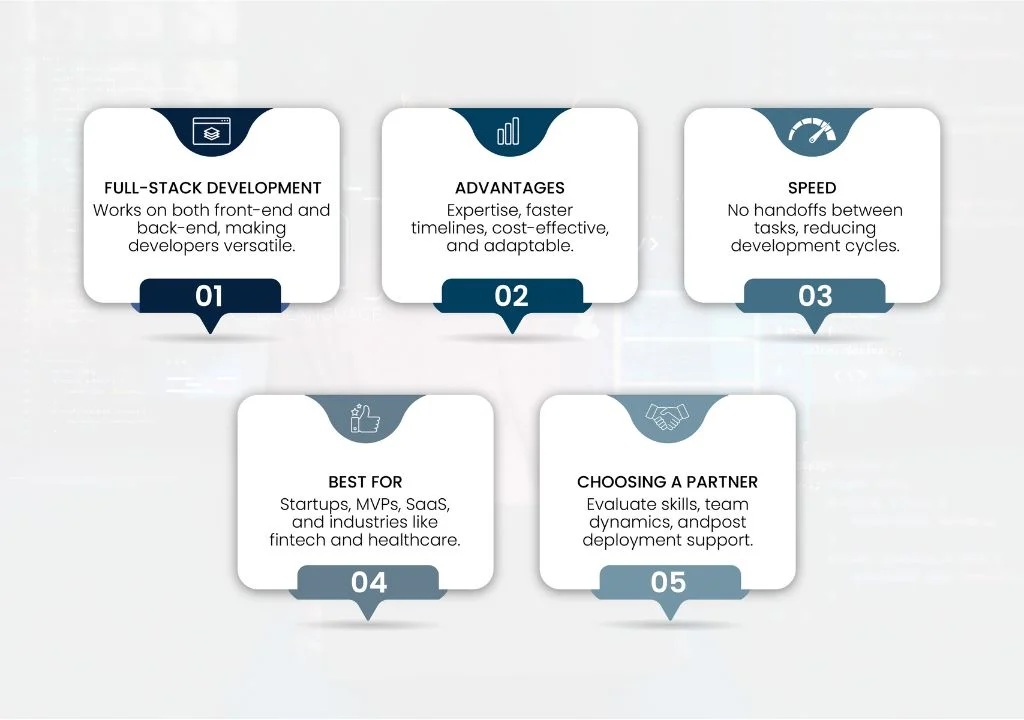
Efficiency is one of the most significant advantages of the cooperation with a full-stack development company. Since full-stack developers possess knowledge in two or more areas, they can easily switch between front-end and back-end work without any delays as they await other teams to provide input or hand-off. This minimizes the breakdown of communication and speeds up the development cycles.
Key Benefits for Projects:
- The decrease in the utilization of various categories of specialists.
- Faster communication among the members of a development team.
- Good Problem Solving of Stacks
The quicker development leads to the event of less time-to-market, which is a very important element in competitive-based industries or in industries with quick product cycles.
3. Cost-Effectiveness
The decision to select a full-stack development partner will save you a lot of expenses in the future. Why? You do not need to have several specialists to maintain each layer of your application; a full-stack team will be able to do all the work, and it will save a lot of overheads. You will have access to a team of professionals who are able to act as:
- Front-end developers
- Back-end developers
- Full-stack developers are especially economical in cases when the startup, SME or enterprise is working on the projects that involve cost optimization and flexibility
- Database architects
Stat Insight: According to surveys, businesses are reporting a cost saving of up to 40 percent when they use full-stack teams as compared to the use of various specialized firms in development.
4. Seamless Project Management
Full-stack developers provide more project control as they work on both the client-side and server-side of the coding. This is a full-fledged participation that helps them to facilitate the project processes and overcome the possible communication barriers among teams.
How They Help:
- There will be certain integration issues and it is better to overcome them beforehand.
- Eliminate any administrative obstacles that are not necessary by having the project roadmap.
- Make sure that databases, servers, and elements that face the users are in harmony.
When you collaborate with a full-stack team, the whole process will be easier. Their overall knowledge will ensure that there are fewer mistakes and this can be translated to long-term results.
5. Adaptability and Future-Proofing
The good things about the Future-Proof are: They are also proficient in different programming languages, frameworks, and tools, which means that they can use new technologies or scale the application to support new business needs very fast.
Scalability of the fact that, it can support more users or data.
Future-Proof Benefits Include:
- The ability to switch between tech stacks without any problem in case of a change in requirements of a project.
- Such flexibility is especially valuable in the case of companies operating in the fast-growing industries like FinTech, e-commerce, or SaaS where innovation and expansion happen on a regular basis.
- Possible Situation: A new company can begin with a minimal viable product (MVP) and increase its demands with the increase in the number of users.
Example Scenario: The MVP can be scaled to a full application without switching teams because a full-stack development partner will be able to do it. Examples of Strategic Full-stack developer
Strategic Use Cases for Full-Stack Development Partners
Small Businesses and Startups
Startups usually have to provide quality applications in a short time with low budgets. A full-stack development partner is the one that can provide the expertise and cost-efficiency to launch an MVP or a prototype and enable iterative enhancement in the long run.
Use Case Example: A health-tech startup can hire full-stack developers to develop a mobile app that would help schedule and bill patients, and it needs minimal investments in resources.
Enterprise-Level Applications
SaaS Projects or Cloud based Solution Full-stack developers are able to come up with modular and scalable architectures that will make the application efficient even as the business increases in demand.
Cloud-Based Solutions or SaaS Projects
Full-stack partnerships are advantageous to many of the cloud-based applications because they require a sophisticated approach to scalability, API integration, and data management.
Key Focus Areas Include:
- Increasing the user retention through the application of front-end responsiveness.
- Incorporation of powerful back-ends that are real-time.
- Next to it are seamless integrations with the third party platforms or APIs.
Custom Development Projects
The front-end and back-end tend to have a lot of coordination when it comes to custom solutions. The all-round capabilities of full-stack development teams make them the best to customize applications that are used in unique business models.
Some of the examples of industries that can benefit from the development of custom full-stack solutions are logistics, fintech, and healthcare.
How to Choose the Right Full-Stack Development Partner
Evaluate their portfolio and take into account the projects that were scaled and required real-time as the primary factors.
Proven Expertise
The only thing that should be in possession of a full-stack partner is technical skills, as he or she should also be experienced in the agile workflow and cross-disciplinary cooperation.
Team Dynamics
Choose the partners that will sustain and upgrade a deployment in order to make success sustainable.
Communication Skills
Effective communication is also a guarantee of easy implementation of projects, particularly long-term or iterative projects.
Post-Deployment Support
Regardless of whether it is the reduction of spending, acceleration of the project timeline and ensuring flexibility, working with a full-stack team can benefit both in the short and long term.
Final Thoughts
A full-stack development partner is not just a source of people to get your projects done, they are a strategic partner who is better placed to assist you in innovating, scaling and optimizing your development process. Full-stack skills will be the future-proof decision that will offer an exceptional value regardless of whether you are working on a startup MVP or an enterprise system.
Choosing such a partner is a long process, but by doing so, you will not only satisfy the current requirements of your project but also establish a long-term growth and flexibility. Full stack is a long-term investment that will bring an excellent value both in the MVP of a startup and in the enterprise solution.
FAQs:
1. What is full-stack development and why is it important?
Full-stack development refers to the ability to work on both the front-end (user interface and experience) and back-end (server logic, databases) of an application. Full-stack developers can handle all facets of a project from conceptualization to deployment, making them versatile and efficient.
2. What are the main advantages of partnering with a full-stack development team?
Key benefits include comprehensive expertise across technologies, faster development timelines due to reduced communication delays, cost-effectiveness by consolidating roles, seamless project management, and adaptability to evolving business needs.
3. How does a full-stack partner speed up project delivery?
Since full-stack developers can switch between front-end and back-end tasks without waiting for handoffs, development cycles are shorter. This leads to faster time-to-market and better agility in competitive industries.
4. In what types of projects is working with a full-stack development partner most beneficial?
Full-stack teams are ideal for startups needing MVPs on tight budgets, enterprise-level SaaS projects requiring scalable architectures, and custom development projects in industries like fintech, healthcare, and logistics where seamless coordination is critical.
5. How should I choose the right full-stack development partner?
Evaluate their portfolio for scalable, real-time projects, assess technical skills and agile experience, consider team dynamics and communication effectiveness, and ensure they provide reliable post-deployment support for sustainable project success.