
Small or medium-sized business is fraught with a lot of challenges and one of the most critical ones is management of finances. The good accounting will not only streamline your operations, but will also save you time and money. Yet, not all business owners are good at maintaining their boo ks in shape as they either have no time or do not have the necessary skills.
To make it easier, here are seven tips on accounting that every small and medium business (SMB) owner should apply. These tips will assist you in ensuring that your financial health remains better and make wiser decisions about your business in terms of its future.
1. Separate Personal and Business Finances
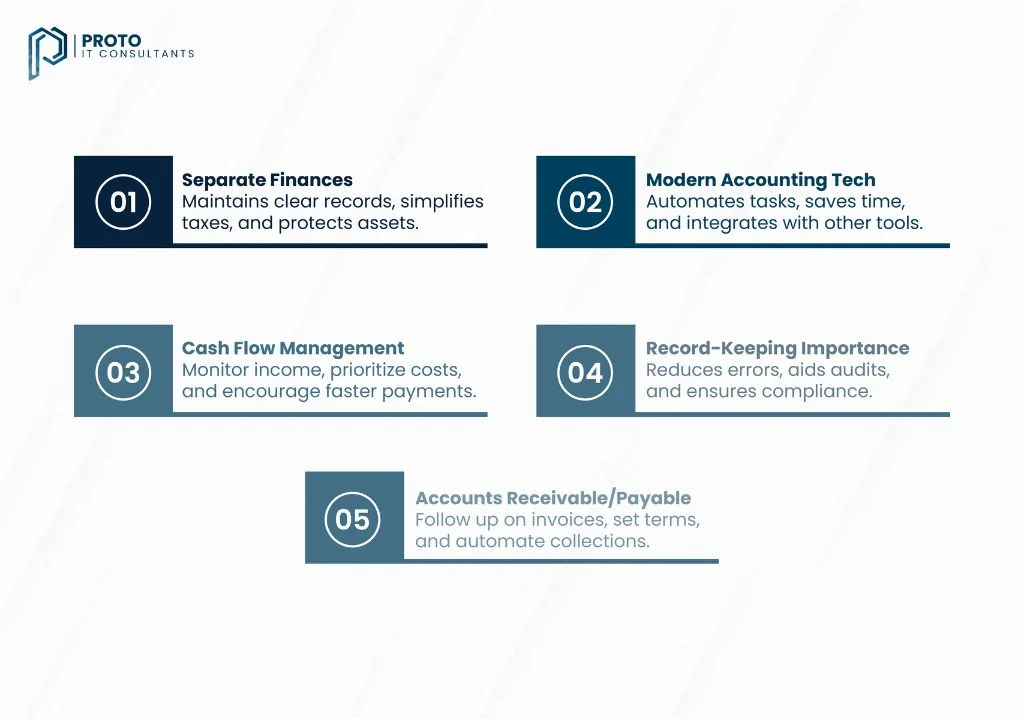
Separation of personal and business finances is one of the first errors that new business owners commit. This leaves behind a paper trail that is confusing, tax time is stressful, and financial mismanagement can occur. The best way to prevent these problems is to open a business bank account as soon as you start your business.
Why Separate Finances?
- Proper Financial Records: Separation of personal expenses and business expenses will help you to have proper records of the company performance.
- Simpler Tax Filing: Tax filing is simplified because it is easy to deduce business expenses that are deductible and personal expenses.
- Enhanced Legal Protection: In case you possess a registered business entity like a limited liability company or a corporation, your separation between you and the business can be jeopardized when you mix money.
Pro Tip: Opening a separate bank account may be too much of a challenge, but to begin with, you can use a particular credit card to purchase only business-related items. Put all the costs related to the workplace on it to document them.
2. Adopt Modern Accounting Technology
The era of writing down transactions or use of spreadsheets is long gone. With the help of modern accounting software, it is now possible to manage your finances in a much quicker, more precise and less time-consuming manner.
Benefits of Using Accounting Technology
- Automation: With QuickBooks or Xero, it is less time-consuming to maintain transactions, generate invoices, and calculate tax.
- Cloud Access: The cloud-based systems will enable you to access the financial data on any device at any time.
- Integration: Most of the current systems are compatible with payment gateways and tax filing tools, which help to minimize errors and make operations leaner.
Some of the features that you should look out in terms of accounting software include the ability to provide real-time reports, expense tracking and automated invoicing. These tools are not only time-saving but also allow one to gain insights that facilitate good decision-making.
Pro Tip: Start with the basic features and software and upgrade as your business becomes more complex.
3. Stay on Top of Cash Flow
Cash flow can be the deal breaker or deal maker of the SMB owners. Cash flow management involves making sure that you are not short of liquidity to meet operational costs and planning to expand in the future.
How to Effectively Manage Cash Flow
- Monitor Your Income and Expenses: You are supposed to monitor your financial accounts to be aware of the amount of money coming in and out.
- Set up a Budget: Create a cash flow budget that is realistic, and has fixed costs like salaries, rent, and utilities.
- Seasonal Planning: Businesses have their ups and downs; it is always advisable to save during the high periods so that you can use it during the low periods.
- Reduce Payment Cycles: encourage customers to pay faster by offering them discount in case of early payment or by having automated billing.
Pro Tip: Cash flow forecasting tools are also available that can assist you to predict financial needs in future based on the past trends and market conditions. It is always better to plan in advance so as to avoid bad surprises such as lack of funds to meet payroll or rent.
4. Keep Detailed and Organized Records
An efficient accounting is based on good record-keeping. In addition to being a legal requirement, it reduces errors, accelerates the process of auditing and helps in tax preparation.
Tips for Maintaining Organized Records
- Record All Transactions: Keep a record of all business transactions including the small ones. Other expenses such as office supplies or travel may not appear to be big but they can accumulate to huge deductions.
- Go Paperless: Adopt the paperless system by using digital receipts, e-invoices, or scanning apps to ensure that there is no cluttered and paper-intensive system.
- Make Regular Reviews: Take at least 30 minutes a month and reconcile the accounts and straighten out any discrepancies at one go.
Pro Tip: It is always good to maintain a back up of your financial records in more than one place (e.g., cloud storage and external drives) to avoid losing data due to technical problems.
5. Streamline Accounts Receivable and Payable
Accounts payable (AP) and accounts receivable (AR) management becomes streamlined, and it does not only affect your cash flow, but also defines how stable your operations are. Late payment collection or missed bill payment may cause disturbance in your finances.
Best Practices for AR and AP
- Receivable Follow-Up: Reminders and follow-up email should be done to ensure that the clients settle their bills within the required time. Automated invoicing software can do such work on your behalf.
- Payment Terms: Be clear to the clients on the payment terms and late payment charges.
- Payable Schedules: Do not leave bill payments to the last minute by setting reminders on when to pay the bills.
Did you know that companies that implement instant-payments solutions cut down turnaround times by as much as 40 percent? By incorporating quicker payment methods or automated billing programs, you will no longer spend so much time trying to collect money and instead you will have more time to manage your business.
6. Seek Professional Help When Necessary
It seems like accounting is an easy task, but as your business grows, other problems like payroll taxes, depreciation, or compliance audit can arise. An accountant or bookkeeper is a professional and guarantees professionalism.
Benefits of Professional Help
- Tax Compliance: Professionals are aware of the tax rules and are capable of ensuring that you take all the available deductions or credits.
- Proper Reporting: Professional bookkeepers help you to make accurate reports of the health of your business.
- Recommendation on Expansion: Accountants who are familiar with your industry will be able to give you tips and prospects of expansion.
Pro Tip: In cases where outsourcing of accounting services monthly or quarterly is too expensive, hire a full time assistant.
7. Keep It Simple
Simplification is one of the key elements that SMB owners fail to implement in their accounting systems. Having complex software or elaborate measures is helpful, but simplification of the processes is more effective in maintaining the focus and minimizing errors.
It is not difficult to make it simple:
- Keep it Simple: Rather than coming up with an intricate system of expense categories, keep it simple by using categories such as supplies, salaries, marketing and utilities.
- Automate Repetitive Work: Repetitive work such as recurring invoices, salary payment and expense tracking can be automated.
- Do Not Fall into Analysis Paralysis: Reports are good but you cannot over analyze all those microtrends. Pay attention to such metrics as profits and customer acquisition costs.
Pro Tip: Re-evaluate your financial objectives at regular intervals to check whether your systems are in accordance with your business needs at that time. Streamlining operations now brings about tranquility in the future.
Final Thoughts and Next Steps
It can be quite intimidating to adopt these accounting practices but every attempt is worth its weight in gold in the long run. Division of finances, utilization of technology, and consultation of professionals whenever they are needed can be great steps in alleviating financial stress.
Your Next Step: Develop a plan of action. Start by finding out weak points in your existing accounting system and then focus on the tips that would help you with those weak points. Whether you are deciding on the best accounting software to use or seeking the help of a professional tax advisor, make one step towards financial health today, and you will be on your way to financial well being.
The key to keeping your business afloat is to remain organized, proactive, and open to implementation of new tools and strategies that will enable your business to grow and succeed in the future.
FAQs: Top 7 Accounting Tips for Small and Medium Business Owners
1. Why is it important to separate personal and business finances?
Separating finances helps maintain clear and accurate financial records, simplifies tax filing, and protects your personal assets by preserving the legal distinction between you and your business.
2. How can modern accounting technology benefit my business?
Accounting software like QuickBooks and Xero automates transaction recording, invoicing, and tax calculation, saves time, reduces errors, offers cloud access for anytime data retrieval, and integrates with other tools.
3. What is the best way to manage cash flow for an SMB?
Monitor income and expenses regularly, create a realistic budget prioritizing fixed and variable costs, plan for seasonal fluctuations, and encourage faster payments through incentives or automated billing.
4. How important is record-keeping in accounting?
Detailed, organized records reduce errors, accelerate audits, aid tax preparation, and legal compliance. Using digital tools for paperless record-keeping and regular reconciliations ensures accuracy and data security.
5. How should I handle accounts receivable and payable effectively?
Follow up on unpaid invoices with reminders, establish clear payment terms, automate invoicing and collections, and schedule bill payments timely to maintain stable cash flow and operational continuity.