

Most economies depend on small and medium enterprises (SMEs) as they are the drivers of innovation, employment, and revenue generation. However, they tend to have special problems especially when it comes to their finances. Budgeting and cash flow management are two major pillars of business success not only as administrative activities but also as essential means of sustenance and growth.
To the owners and managers of SMEs, knowledge of the principles of budgeting and how to manage the cash flow effectively is the difference between prospering and struggling. This paper discusses the reasons why these aspects cannot be ignored, the most widespread difficulties, and the ways SMEs can utilize to achieve success.
Understanding the Financial Landscape for SMEs
SMEs do not have a lot of financial flexibility like large corporations that have access to vast resources. They depend so much on the regular flow of revenue to meet their daily operating costs and therefore are vulnerable to cash flow interruptions. The liquidity crisis can be caused by one late payment of a customer, a surprise bill or even a recession.
Why Budgeting is Essential for SMEs
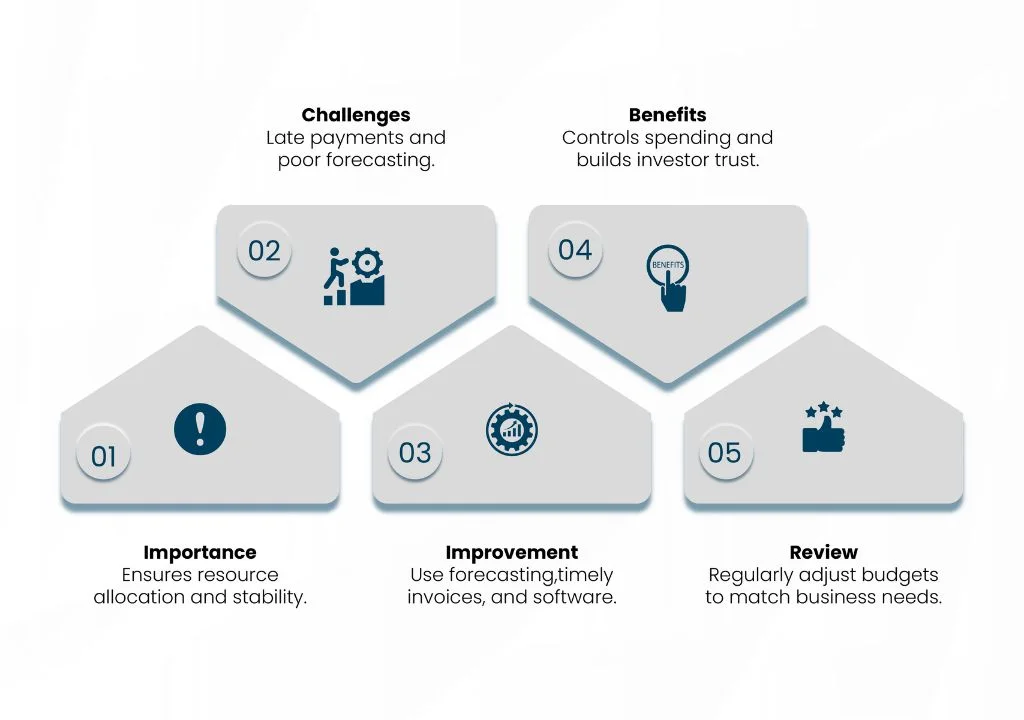
Budgeting is more than tracking the expenditure. It is the blueprint of financial plan of your business that allows you to plan the allocation of resources, foresee the challenges and plan the growth. The following are some of the major ways that a good budget can be useful to SMEs:
1. Enhanced Financial Control
In the absence of a budget, one can find it simple to get out of control of spending. The problem with business owners who operate on gut feelings, or do ad-hoc analysis is that they end up overspending in low priority areas. An effective budget gives a clear picture of the revenue and expenditure and thus the managers can make a decision where to cut down or invest more.
To illustrate, a SME that has a budget of 30,000 dollars a month and uses 10,000 dollars on marketing may realise that there is a better-than-anticipated return on investment (ROI) in digital advertising, and decide to allocate more funds to the channel.
2. Improved Decision-Making
Any business decision that is of critical importance such as introduction of a product, taking up more employees, among others has an effect on the finances. Having a budget, SMEs are able to analyze the consequences of such decisions prior to making them. Business owners will be able to foresee situations like cash crunch and will be able to know how financially viable goals like expansion or new investments are.
3. Proactive Risk Management
Some of the challenges that SMEs may face include economic fluctuations, rising costs, or operational setbacks among others. The existence of a certain part of the budget as contingency funds will help to make sure that the unexpected expenses will not disrupt the business. As an example, a retail SME that has a seasonal lull can use the saved reserves to cover the payroll without having to take out the high-interest loans.
4. Facilitating External Funding
A budget can be one of the initial documents that potential lenders or investors ask SMEs that are in need of loans or investments. It shows financial planning, stability and responsibility and this is a better case in getting funds.
Cash Flow Management: The Lifeblood of SMEs
he budgeting determines the plan but cash flow management is what makes it work Cash flow refers to the in-flow and out-flow of the money in business. Proper management of cash flow ensures that the cash is available to cover short-term needs and at the same time it helps in the long-term growth. The reason it is important is as follows:
1. Avoid Liquidity Crises
Financial inflows may be hindered by late payment of clients or late delivery of orders. SMEs do not always have big reserves, so such disturbances may result in the failure to pay suppliers, fines, or bankruptcy. Among the solutions, strict payment terms and accounting software to monitor receivables can be brought forward.
As an example, an IT SME can use a payment system of 50 percent upfront, 50 percent on delivery to reduce the risk and enhance the stability of the cash flow.
2. Building Stakeholder Trust
The suppliers, employees and the creditors all rely on the capacity of the business to pay on time. Inefficient cash flow management may ruin the relationships with the following stakeholders, lowering the goodwill and possibly resulting in tighter credit terms or operation bottleneck.
3. Supporting Business Growth
Expansion usually needs initial investments- be it technology, marketing or other personnel. A good cash flow management strategy will allow businesses to invest in their firms without compromising their capacity to meet their operational costs.
Key Challenges SMEs Face in Managing Budget and Cash Flow
Financial planning and control are among the problems that many SMEs face as a result of various challenges:
1. Late Payments
Customer late payments is an endemic problem. The 2023 SME Insights report has found that 65 percent of SMEs consider delayed customer payments as an issue, with 22 percent of them owing 10,000-30,000 dollars in late payments.
2. Lack of Accurate Forecasting
Most SMEs lack effective cash flow forecasting and budgeting tools and hence it is not easy to predict shortages or times of excess.
3. Limited Financial Expertise
SMEs do not necessarily have financial experts in-house as is the case with bigger organizations. Owners tend to be wearing many hats and this includes financial management and this provides a margin to make mistakes or miss out.
4. Economic Uncertainty
The best financial plans may be broken by high inflation or a volatile market demand.
Actionable Strategies for Effective Budgeting and Cash Flow Management
These issues should be handled in a strategic way. The tips that can help SMEs to put their finances under control are the following:
1. Create a Realistic Budget
Begin with the estimation of revenues on the basis of the past performance and future opportunities. Isolate the fixed costs (e.g. rent and salaries) and variable costs (e.g. raw materials) so as to determine the areas where you can make adjustments in spending. Budgeting software will help in making the process efficient and accurate.
2. Implement Cash Flow Forecasting
Prepare monthly cash flow projections to be aware of the shortages between the revenue and expenditure. These projections are supposed to be reviewed on a regular basis to reflect new information or changes taking place in the business environment. This is a proactive method which assists the owners in identifying problems before they get out of hand.
3. Enhance Payment Collections
To combat late payments:
- Send invoices immediately upon order fulfillment.
- Offer incentives like small discounts for early payments.
- Introduce fines on late payments so that payments can be made within the stipulated time.
Automated software solutions can also improve invoicing efficiency and accuracy.
4. Control Operating Costs
Conduct a review of your expenditure on a regular basis to find out where you can cut down. For instance:
- Make better deals with the suppliers.
- Buy energy efficient devices so that in the future there will be fewer utility bills.
5. Secure Short-Term Finance
Small business loans or trade financing could essentially be one of the ways to fill such gaps strategically, but do remember to be cautious of interest rates. Line of credit can be used as a cushion by businesses that have frequent cash flow deficits.
6. Monitor Financial Metrics Regularly
Financial health can be tracked by measuring such metrics as operating cash flow ratio and accounts receivable turnover. Reviews on regular basis reveal the gaps that can be adjusted in time.
7. Educate Your Team
Train the heads of the departments on the basics of budgeting and the need to keep track of the cash. This will provide a buy-in at all levels in the organization and enhance a culture of financial responsibility.
8. Leverage Technology
With the help of modern accounting software such as Xero, Sage, or QuickBooks, it becomes simpler to keep an eye on the cash flow, create a budget and follow the financial progress. Most of them have also automation features that minimize human error and time wastage.
Final Thoughts
Budgeting and cash flow management are not just administrative practices they are life saving mechanisms to small and medium sized enterprises. When having a clear roadmap of the finances and keeping the liquidity at any time, companies will be able to approach the challenges, such as late payments or unforeseen expenses, with more confidence.
To SME owners and managers, the reorientation to these financial fundamentals will help to reduce risks, but more importantly, it will put the business on a sustainable growth path. As an organization, you may be starting out or looking to scale, but one thing that will ensure your organization is on a journey to long term success is by putting emphasis on financial planning.
Meta Title:
Budgeting and cash flow tips for SMEs to boost financial health
Meta Description:
Discover effective budgeting and cash flow strategies for SMEs. Learn how to improve financial health, manage risks, and fuel sustainable business growth.
FAQs: Why Budgeting and Cash Flow Management are Crucial for SMEs
1. Why are budgeting and cash flow management important for SMEs?
Budgeting helps SMEs plan and allocate resources effectively, control expenses, and foresee challenges. Cash flow management ensures there is enough cash to cover day-to-day expenses and supports sustainable business growth by avoiding liquidity crises.
2. What challenges do SMEs commonly face with budgeting and cash flow?
SMEs often struggle with late customer payments, inaccurate forecasting, limited financial expertise, and economic uncertainties, which can disrupt cash flow and lead to financial instability.
3. How can SMEs improve cash flow management?
They can implement cash flow forecasting, send timely invoices, offer incentives for early payments, enforce payment penalties, control operating costs, and use accounting software to automate and monitor finances efficiently.
4. What are the benefits of maintaining a realistic budget?
A realistic budget provides financial control, helps SMEs prioritize spending, avoid overspending in low-priority areas, prepare for unexpected expenses with contingency funds, and build trust with lenders or investors.
5. How often should SMEs review and adjust their budgets and cash flow plans?
SMEs should regularly monitor financial metrics and review budgets monthly or quarterly to identify variances and adjust plans timely, ensuring alignment with current business conditions and goals.