Small and medium enterprises have their own specifications of challenges that are not common with large corporations. The tight budgets, resource scarcity, and the ever-present need to do more with less make each business decision a very heavy one. The high cost and complex implementations of the traditional ERP systems usually makes it impossible to manage a business comprehensively when it comes to the growing companies.
Then there is Odoo ERP, which is a game changer that brings everything to the same playing field. This open-source system has revolutionized the way SMEs perform business management, and it provides enterprise level functions at a fraction of the cost. Odoo has more than 1 million businesses all over the world using it to organize their operations, making it more than a simple software.
The affordability of Odoo is not the only thing that makes it stand out; it is also capable of expanding with your business. Whether you are a startup that wants to build efficient processes or an established SME that wants to grow, Odoo offers the flexibility and scalability that will help you on your way.
The SME Challenge: Why Traditional ERPs Fall Short
The environment in which small and medium businesses operate is constrained, and the traditional ERP solutions are not viable. Such companies are often constrained by budgetary constraints and as a result, they end up using fragmented software tools which result into data silos that becomes a hindrance to productivity and decision making.
Most of the conventional ERP systems are costly to implement, take long periods to implement and their maintenance costs may be too high to bear by SMEs. Such systems were developed to meet the needs of big businesses that had their own IT departments and had resources to spare, but they do not fit the lean operational model that most SMEs have to adhere to.
The other obstacle is the complexity of the traditional ERPs. Small businesses should not have systems that take a long time to learn and master by employees but rather small systems that employees can learn and operate in short time.
What Makes Odoo Different
Odoo is a solution to these issues as it presents a completely different approach to the idea of business management software. Constructed as an open-source platform, it does not involve any licensing fees that render other ERP systems too expensive to be used by smaller companies.
The platform is modularly designed, which allows the companies to start with a small usage, and scale it up as needed. It is possible to start with simple modules of accounting and sales, and as the company develops, expand to inventory management, HR, project management, or any of the 100+ of applications available.
This type of scalability is not limited to adding features. The scalable nature of Odoo can handle increased volumes of data and number of users thus the system will not slow down as your business expands.
Key Advantages for SMEs
Cost-Effectiveness That Actually Works
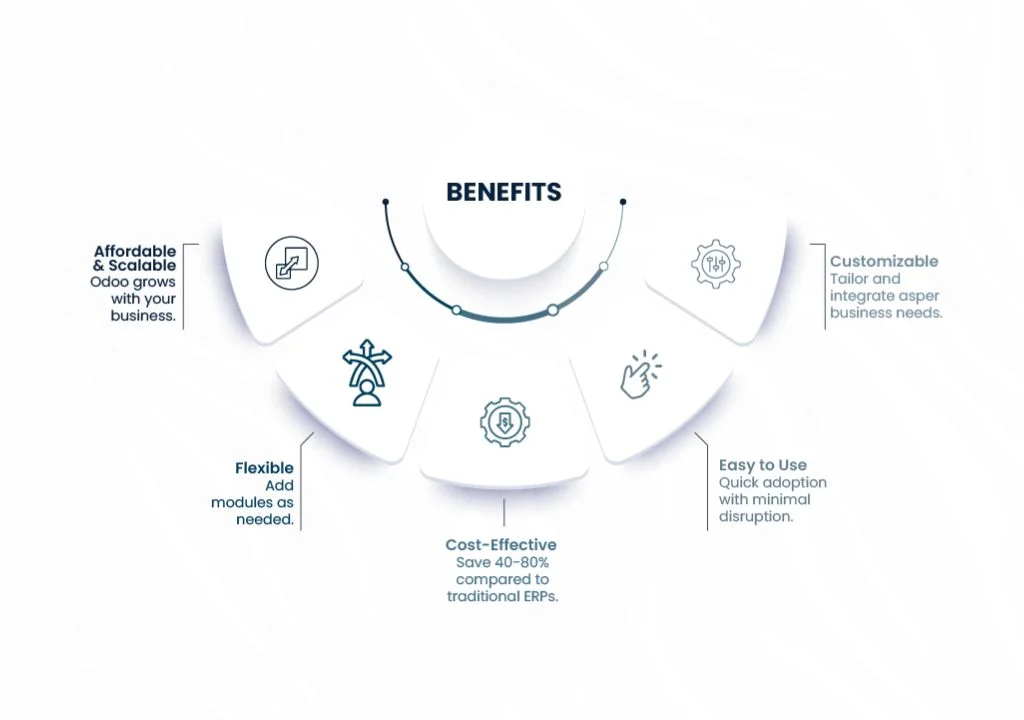
Odoo pricing model converts the ERP pricing to small businesses. The community edition is entirely free and startups can use the necessary business management tools without having to invest any capital. The enterprise version is much cheaper than similar ERP solutions, and as such, it can serve the needs of businesses that need extra features.
This is not only affordable in terms of licensing fees. The Odoo implementation process is simplified, which makes consulting cheaper, and the user-friendly interface makes training less expensive. Most companies have claimed to save between 40 and 60 percent on software when they change to Odoo.
User-Friendly Interface That Employees Actually Use
The ease of use is one of the most significant advantages of Odoo since it has a clean and intuitive interface that does not need much training. Employees are able to use the system quite easily and the learning curve is minimized as it is the case when implementing an ERP. Such ease of use is directly converted into productivity benefits as companies have reported as much as 40 percent decrease in training time.
The interface is also flexible to the various user roles, displaying the information that is needed and concealing the complexity that is not. Sales reps get simplified CRM, the accountants get all the financial tools, and they are all integrated into a single system.
Comprehensive Modular System
Modularity of Odoo addresses all parts of business activities. The platform has dedicated tools that facilitate all business processes such as customer relationship management and sales, inventory, accounting, manufacturing, and human resource.
These modules are designed to work together in harmony, and there is no data synchronization problem that used to be the case with several independent applications. When a sale is registered in the CRM, the inventory levels are automatically updated, accounting entries are created and even manufacturing orders can be generated when required.
Flexibility and Customization
Each company has its own way of operating and Odoo understands this fact by providing a lot of customization. It is possible to make the platform fit the individual workflows, industry-specific needs, and specific business processes without the costly custom development.
This can be done in reporting and analytics. Businesses are able to build custom dashboards, create special reports and monitor metrics that are of most concern to their operations. The system will grow and change based on the demands of the business.
How Odoo Drives Operational Efficiency
Streamlined Implementation
The Odoo is very simple and fast to set up compared to the traditional ERP systems that can take months or even years to implement. It takes weeks rather than months to get basic functionality in small businesses.
The modularity of the platform means that we can implement it in phases. Businesses can start with simple modules and then add functionality as time goes on with little effect on day to day operations and a gradual distribution of the implementation costs.
Reduced Lead Times and Increased Productivity
The integrated nature of Odoo removes most of the bottlenecks that slows the business processes. Departmental synchronization of data in real time implies that the sales department can see the actual inventory level, accounting can monitor real-time revenue, and the management can have up-to-date information about business performance.
Automated systems ensure that there is a reduction in manual processes and human error. Purchase orders may be automatically created when the inventory levels are low, the invoices may be automatically created after the delivery is received, and customer communications may be automated depending on the predetermined triggers.
Enhanced Data Security and Recovery
Data protection is a major issue in small businesses as they are not always able to afford high-tech IT security. Odoo overcomes this by having multiple layers of protection which include encryption, role-based access controls and security patches.
The cloud-based model has an extensive backup and disaster recovery procedure that has a 24-hour recovery point objective. This type of protection at the enterprise level will provide small businesses with the same level of data protection that large corporations have.
Making the Switch: What to Expect
The process of switching to Odoo does not involve the overhaul of operations. The flexible implementation strategy of the platform enables businesses to transit in phases, without having to change the current processes, but gradually incorporating new functionality.
Odoo is often used by many businesses in its free community version to determine compatibility with their operations. Experienced Odoo partners can do the implementation quicker and can optimally configure it.
Your Path to Streamlined Operations
Small and medium businesses do not have to ask themselves whether they should have an improved operational efficiency or not, but whether they can afford not to have one. The low cost, functionality and flexibility of the platform is what makes it a unique option to businesses that need enterprise level capabilities at SME budgets.
It is modular you can begin with the essentials and as your business grows, you can include attributes to it, so you can be positive that your ERP investment will grow with your success. It is modular and you can start with the basics and as your business grows, you can add features to it, hence you can be certain that your ERP investment will increase with your success.
Odoo has already shown thousands of companies how to revolutionize their operations. The real question is: when will you be joining them to enjoy the advantages of really integrated business management?
FAQs:
1. Why is Odoo ERP more suitable for SMEs than traditional ERP solutions?
Odoo ERP is designed with affordability, simplicity, and scalability in mind. Unlike traditional ERPs that often come with high licensing fees, complex implementations, and steep learning curves, Odoo offers a modular, open-source platform that fits the budgets and needs of small and medium-sized enterprises. It allows SMEs to start small and expand as their needs grow, without overwhelming costs or complexity.
2. How does the modular system of Odoo benefit growing businesses?
Odoo’s modular architecture means businesses can begin with essential applications like sales or accounting and seamlessly add more modules—such as inventory, HR, or project management—as they grow. This flexibility not only ensures businesses aren’t paying for tools they don’t need but also enables them to scale operations efficiently without migrating to a new platform.
3. What makes Odoo ERP cost-effective for small and medium businesses?
Odoo offers a free Community Edition and a competitively priced Enterprise Edition, making it accessible for startups and established SMEs alike. Implementation is typically simpler and cheaper than traditional ERP systems, and the user-friendly interface reduces employee training costs. Many SMEs report software savings of 40-60% after switching to Odoo.
4. Is Odoo ERP easy for employees to use and adopt?
Yes, Odoo is renowned for its intuitive, user-friendly interface. Employees can quickly adapt with minimal training, and the system tailors information based on user roles, making it easier for sales representatives, accountants, and managers alike to access what they need. This streamlined design directly boosts productivity and minimizes implementation disruption.
5. How does Odoo support customization and integration for unique business needs?
Odoo is highly customizable—businesses can tailor workflows, reports, and dashboards as needed without extensive (or costly) custom development. Its open-source nature and large app ecosystem facilitate integration with third-party tools and allow business-specific adaptation, ensuring the platform grows with operational demands.